The Fashion Disaster (Der Mode-Fauxpas) 🤡 | Learn German with a Story
Why is it
📝 Transcript
Click any sentence to jump to that moment in the video. Use the 🔊 button to hear the pronunciation.
Hello everyone and welcome. Yes, I know, adjective endings in German, that sounds like a huge complicated thing at first, right? But don't worry, we'll build a really solid foundation today and you will see, there's a very simple logic behind it. So let's get started right away. So it often all starts with something very everyday. Imagine you're shopping, trying something on and someone says, 'It suits you.' That means something like 'It looks good on you.' Super useful, right?
But what if you want to say what exactly suits you? The new sweater, the red jacket. Well, and that's exactly where adjective endings come into play. We need them to be precise. And here's the whole trick.
Instead of memorizing endless grammar tables, we actually only need to ask ourselves one question. Which word in this small group is in charge here, who dictates the grammatical information? As soon as we know that, the rest is really almost a piece of cake.
To make it super easy for us, I have a little story for you that you can hopefully remember well. The story of the boss and the worker.
And this little metaphor will guide us through the entire logic now. Okay, who is the boss now? Well, the boss is the definite article, der, die, das. And why is he the boss? Well, quite simply, because he's already done all the hard work. He tells us everything we need to know. The gender of the noun, i.e. masculine, feminine, neuter, and what role it plays in the sentence. All these important pieces of information are already contained in this tiny word. So, and who is then
📚 Recommended for this lesson
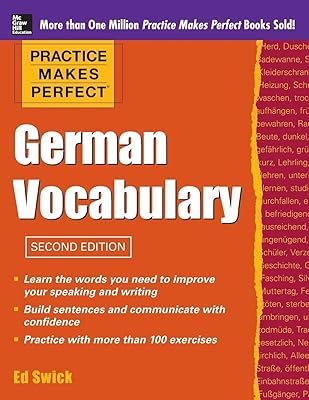
Practice Makes Perfect: German Vocabulary
Ready to drill the words from this episode? Practice with targeted vocabulary exercises.
Check Price on AmazonEnjoying this lesson? Get free episodes every week!
📖 Vocabulary
Key vocabulary from this episode with part of speech, meaning, and example sentences. Practice along with the video above.
| Word | Type | Meaning | Example |
|---|---|---|---|
| der Pullover | Nomen (m.) | the sweater | Der Pullover ist neu. |
| die Jacke | Nomen (f.) | the jacket | Die Jacke ist rot. |
| stehen | Verb | to suit, to look good on | Das Kleid steht dir gut. |
| der Rock | Nomen (m.) | the skirt | Ich trage einen roten Rock. |
| die Hose | Nomen (f.) | the trousers | Die neue Hose passt mir. |
| das Hemd | Nomen (n.) | the shirt | Das Hemd ist blau. |
| rot | Adjektiv | red | Der rote Schal. |
| neu | Adjektiv | new | Das neue Auto. |
| blau | Adjektiv | blue | Die blaue Blume. |
| der Chef | Nomen (m.) | the boss | Der Chef ist nett. |
✏️ Exercises
Test your understanding with fill-in-the-blank and multiple choice questions. Click "Check" to see the answer.
Der ___ Pullover steht dir.
Das ___ Hemd ist sehr schön.
Sie trägt die ___ Hose.
Ich kaufe den ___ Rock.
Die ___ Röcke sind modern.
Er mag das ___ Auto.
Das ist ein ___ Pullover.
Sie kauft eine ___ Tasche.
Wir sehen die ___ Häuser.
Er hat ___ Schuhe gekauft.
📚 Recommended Study Materials
Practice Makes Perfect: German Vocabulary
Ed Swick
Targeted exercises and drills for mastering essential German words and phrases.
Check Price on Amazon
German Made Simple
Eugene Jackson
A complete beginner's guide covering grammar, vocabulary, and conversation essentials.
Check Price on Amazon
Hammer's German Grammar and Usage
Martin Durrell
The definitive reference grammar for serious learners. Covers all levels from A2 to C2.
Check Price on Amazon
Comments