German Grammar Guide: Master the Basics Fast
By LangPodTools Editorial Team, Language Learning Content Specialist

German grammar has a reputation for being hard. Four cases, three genders, verb endings that change depending on who's speaking — it sounds like a lot. But here's the thing most people don't tell you: once you understand the system, it all clicks into place.
This German grammar guide cuts through the confusion. You'll get the core rules, clear tables, real examples, and honest explanations of where learners go wrong. Whether you're at A1 or pushing toward B2, this is the reference you'll keep coming back to.
Why German Grammar Feels Hard (And Why It Isn't)
Most English speakers struggle with German grammar because English lost most of its grammatical cases centuries ago. We don't say "him" vs "he" to signal a noun's role in a sentence anymore — we just use word order instead.
German kept its case system. That means the ending of a word tells you what job it's doing in the sentence. Once you see it that way — as information built into the word itself — it starts to feel less random and more logical.
The payoff is real: German word order is actually more flexible than English, because the endings carry the meaning.
The Three German Genders: Der, Die, Das
Every German noun has a grammatical gender: masculine (der), feminine (die), or neuter (das). This trips up almost every beginner.
There's no perfect shortcut, but there are patterns that cover the majority of nouns.
| Pattern | Gender | Examples |
|---|---|---|
| Nouns ending in -ung | feminine (die) | die Wohnung, die Übung |
| Nouns ending in -heit / -keit | feminine (die) | die Freiheit, die Möglichkeit |
| Nouns ending in -er (agent/person) | masculine (der) | der Lehrer, der Fahrer |
| Nouns ending in -chen / -lein | neuter (das) | das Mädchen, das Büchlein |
| Nouns ending in -ment / -um | neuter (das) | das Dokument, das Zentrum |
| Days, months, seasons | masculine (der) | der Montag, der Winter |
The most common beginner mistake: learning nouns without their article. Always learn der Hund, not just Hund. The gender travels with the word everywhere it goes.
If you want to drill noun genders deeply, The German Alphabet: All 30 Letters with Pronunciation Guide is a great place to start building your vocabulary foundation alongside these patterns.
The Four German Cases: What They Are and When to Use Them
This is the heart of any German grammar guide. The four cases tell you what role a noun plays in a sentence.
| Case | Role | English Equivalent | Signal Words |
|---|---|---|---|
| Nominative | Subject (who/what does the action) | "he", "she", "it" | ist, wird, heißt |
| Accusative | Direct object (who/what receives the action) | "him", "her", "it" | sehen, kaufen, haben |
| Dative | Indirect object (for/to whom) | "him", "her", "them" | geben, helfen, mit, bei |
| Genitive | Possession | "'s" or "of" | wegen, trotz, während |
How the Article Changes with Each Case
The article (der/die/das) changes form depending on the case. This is the table you'll want to memorize.
| Case | Masculine | Feminine | Neuter | Plural |
|---|---|---|---|---|
| Nominative | der | die | das | die |
| Accusative | den | die | das | die |
| Dative | dem | der | dem | den |
| Genitive | des | der | des | der |
A quick sentence to see all four cases at work:
Der Mann (nom.) gibt dem Kind (dat.) den Ball (acc.) des Spielers (gen.). "The man gives the child the player's ball."
Notice how each noun's article signals exactly what role it plays — you don't need word order to figure it out.
The Most Common Beginner Mistake with Cases
Learners often mix up accusative and dative. The fix: accusative is for the thing directly affected. Dative is for the person (or thing) that receives or benefits.
- Ich kaufe den Kaffee. (I buy the coffee — accusative, direct object)
- Ich gebe dem Mann den Kaffee. (I give the man the coffee — the man is dative, he receives)
German Verb Conjugation: The Core Pattern
German verbs change their endings based on the subject. The regular (weak) verb pattern looks like this:
| Pronoun | Ending | Example: spielen (to play) |
|---|---|---|
| ich | -e | ich spiele |
| du | -st | du spielst |
| er/sie/es | -t | er spielt |
| wir | -en | wir spielen |
| ihr | -t | ihr spielt |
| sie/Sie | -en | sie spielen |
Most verbs follow this pattern. Once you've drilled it, you can conjugate thousands of verbs automatically.
Strong (Irregular) Verbs
Irregular verbs change their stem vowel in the du and er/sie/es forms. These need to be memorized individually, but the endings stay the same.
| Infinitive | ich | du | er/sie/es |
|---|---|---|---|
| fahren (to drive) | fahre | fährst | fährt |
| lesen (to read) | lese | liest | liest |
| nehmen (to take) | nehme | nimmst | nimmt |
The good news: there aren't that many of them, and they're the most common verbs — so you'll see them constantly and absorb them fast.
Modal Verbs
Modal verbs (können, müssen, dürfen, wollen, sollen, mögen) express ability, obligation, or desire. They have their own conjugation pattern and kick the main verb to the end of the sentence.
Ich kann heute nicht kommen. (I can't come today.)
For a deep dive into how tenses interact with verb forms, check out All 6 German Tenses Explained: A Complete Guide for Beginners.
German Sentence Structure: The Verb-Second Rule
German has a strict rule: the conjugated verb must always be the second element in a main clause. Always. No exceptions.
This trips up English speakers because we're used to the subject always coming first. In German, you can front almost anything — a time expression, an adverb, an object — and the verb simply swaps places with the subject.
Heute gehe ich einkaufen. (Today I'm going shopping.) Ich gehe heute einkaufen. (I'm going shopping today.)
Both sentences are correct. The verb gehe stays in position 2 no matter what.
Subordinate Clauses: Verb Goes to the End
In subordinate clauses (introduced by words like weil, dass, wenn, obwohl), the verb jumps to the very end.
Ich lerne Deutsch, weil es interessant ist. (I'm learning German because it's interesting.)
This is one of the most common mistakes in spoken German. Native speakers will understand you either way, but nailing verb placement makes you sound dramatically more fluent.
German Prepositions and Their Cases
Prepositions in German are case triggers. Each preposition locks the following noun into a specific case.
Always Accusative
durch, für, gegen, ohne, um, bis, entlang
Das Geschenk ist für den Mann. (The gift is for the man.)
Always Dative
aus, bei, mit, nach, seit, von, zu, gegenüber, ab
Ich fahre mit dem Bus. (I'm going by bus.)
Two-Way Prepositions (Accusative or Dative)
These prepositions switch cases depending on meaning:
- Accusative = movement/direction (Wohin? — Where to?)
- Dative = location/state (Wo? — Where?)
an, auf, hinter, in, neben, über, unter, vor, zwischen
Ich lege das Buch auf den Tisch. (I'm placing the book on the table — movement, accusative) Das Buch liegt auf dem Tisch. (The book is on the table — location, dative)
This distinction is one of the most elegant and logical parts of German grammar once you see the pattern.
German Adjective Endings: The Final Puzzle Piece
Adjectives between an article and a noun need endings that reflect the gender, case, and whether you're using der/die/das (definite) or ein/eine (indefinite).
With a definite article (der, die, das), the "strong" ending is already on the article, so the adjective takes a weak ending:
| Case | Masculine | Feminine | Neuter | Plural |
|---|---|---|---|---|
| Nominative | -e | -e | -e | -en |
| Accusative | -en | -e | -e | -en |
| Dative | -en | -en | -en | -en |
| Genitive | -en | -en | -en | -en |
Das ist der alte Mann. (That's the old man.) Ich sehe den alten Mann. (I see the old man.)
For the full breakdown with mixed and strong adjective endings, German Adjectives: The Complete Guide to Declension and Usage covers every pattern with examples.
German Nouns: Capitalization and Plurals
One rule you'll love: every German noun is capitalized, no matter where it sits in a sentence. This actually makes reading easier — you can spot nouns at a glance.
Plural forms, unfortunately, don't follow a single rule the way English does (just add -s). German has several plural patterns:
| Pattern | Singular | Plural |
|---|---|---|
| Add -e | der Tag | die Tage |
| Add -er + umlaut | das Buch | die Bücher |
| Add -en | die Frau | die Frauen |
| Add -s (loanwords) | das Auto | die Autos |
| No change | der Lehrer | die Lehrer |
The strategy: learn the plural form when you learn the noun. Treat it as three-part vocabulary — article, noun, plural (e.g., der Hund, die Hunde).
Adverbs in German: Easier Than You Think
Here's a relief: most German adjectives can be used directly as adverbs without any change in form. No -ly suffix needed.
Das Auto ist schnell. (The car is fast.) — adjective Er fährt schnell. (He drives fast.) — adverb, same word
Position matters though. Adverbs generally follow the order: Time → Manner → Place (Temporal, Modal, Lokal = TeKaMoLo).
Er fährt heute (time) schnell (manner) in die Stadt (place). (He's driving fast to the city today.)
A 4-Week German Grammar Learning Plan
Here's a practical path through this German grammar guide if you're starting from scratch:
| Week | Focus | Daily Practice |
|---|---|---|
| Week 1 | Noun genders + Nominative/Accusative | Flashcards with der/die/das, basic sentences |
| Week 2 | Dative case + core prepositions | Preposition drills, daily journaling |
| Week 3 | Verb conjugation + sentence structure | Conjugation tables, shadowing podcasts |
| Week 4 | Adjective endings + Genitive | Reading short texts, writing paragraphs |
Pair this with listening practice — podcast episodes are especially good for hearing how these grammar patterns sound in natural speech.
Common Mistakes to Avoid
Even intermediate learners make these errors repeatedly:
- Forgetting case after prepositions — check whether your preposition always takes one case or switches between accusative and dative.
- Using accusative instead of dative with indirect objects — if you can ask "to whom?" or "for whom?", it's dative.
- Putting the verb in the wrong position in subordinate clauses — the verb goes to the end after weil, dass, wenn, etc.
- Learning nouns without their gender — this creates problems in every other part of grammar. Always learn the article.
- Overcomplicating adjective endings early on — focus on nominative and accusative first, then add dative. Don't try to memorize all forms at once.
Progress in German grammar isn't linear, but every piece you lock down makes the next one easier. Use this guide as a reference you return to, not a one-time read.
Frequently Asked Questions
What are the four cases in German grammar?▾
How do I learn German noun genders?▾
Is there a free German grammar guide PDF?▾
What is the hardest part of German grammar for English speakers?▾
What German grammar level should I focus on as a beginner (A1)?▾
How does German sentence structure differ from English?▾
Do German adjectives change form?▾
Recommended Study Material
The Complete German Grammar Cheat Sheet
A1–B2 Reference PDF
27 pages of color-coded tables, mnemonics, and shortcuts — every rule you need from Cases to Subjunctive.
Recommended German Books

Short Stories in German for Beginners
Olly Richards
Learn German with 8 captivating stories. Perfect for A2-B1 learners who want to build vocabulary naturally.
Check Price on Amazon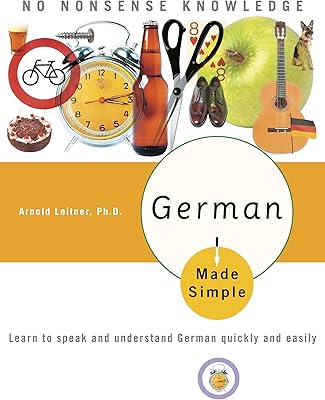
German Made Simple
Eugene Jackson
A complete beginner's guide covering grammar, vocabulary, and conversation essentials.
Check Price on Amazon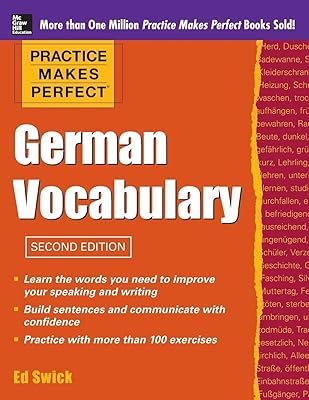
Practice Makes Perfect: German Vocabulary
Ed Swick
Targeted exercises and drills for mastering essential German words and phrases.
Check Price on AmazonAs an Amazon Associate, we earn from qualifying purchases.