Essential German Words Every Learner Needs (Top 50 + Categories)
By LangPodTools Team, Language Learning Content Specialist

You don't need to memorize every word in a dictionary to hold a real German conversation. Research consistently shows that the 300 most common words in any language cover roughly 65% of all spoken text — and the top 1,000 cover about 90%.
That's the 80/20 rule applied to language learning: a small core of high-frequency words carries the majority of the conversational load. Focus there first, and everything else builds faster.
This guide gives you the essential German words organized by category, tables to bookmark, a section on tricky false friends, and a strategy for finding the exact words that appear most in real German podcasts.
Why High-Frequency Words Are the Fastest Path to Fluency
Most beginners start with themed lists — colors, food, animals. Those are fun, but low-frequency. You might use "purple" once a month, but you'll use und (and), nicht (not), and haben (to have) hundreds of times a day.
Frequency-based learning flips the script: instead of learning vocabulary you might need, you learn vocabulary you will definitely need. Analyses of the Leipzig Corpora for German confirm the pattern — a tiny core vocabulary carries an outsized share of real-world communication.
Study Tip: Work through this list before branching into topic vocabulary. Once you have a solid high-frequency base, unknown words become much easier to guess from context — especially in podcasts.
Greetings and Farewells
Every German conversation starts and ends here. These words are also among the most emotionally memorable, which means they stick faster.
| German | English | Notes |
|---|---|---|
| Hallo | Hello | Universal casual greeting |
| Tschüss | Bye | Everyday informal farewell |
| Bitte | Please / You're welcome | One word, two jobs |
| Danke | Thank you | Add sehr for "thank you very much" |
| Entschuldigung | Excuse me / Sorry | Use when bumping into someone or asking for attention |
| Ja | Yes | Sounds like "yah" |
| Nein | No | See also: How to Say No in German |
| Bis bald | See you soon | Lit. "Until soon" |
| Auf Wiedersehen | Goodbye (formal) | Lit. "Until we see again" |
For regional variants (Grüß Gott, Moin, Servus), see our Guten Tag guide.
Numbers 1–10
Numbers unlock prices, times, addresses, and phone numbers. These ten words will pay off immediately.
| Number | German |
|---|---|
| 1 | eins |
| 2 | zwei |
| 3 | drei |
| 4 | vier |
| 5 | fünf |
| 6 | sechs |
| 7 | sieben |
| 8 | acht |
| 9 | neun |
| 10 | zehn |
Once you know 1–10, higher numbers follow: elf (11), zwölf (12), dreizehn (13).
Question Words
Question words are multipliers. Each one unlocks an entire category of conversation.
| German | English |
|---|---|
| Was? | What? |
| Wer? | Who? |
| Wo? | Where? |
| Wann? | When? |
| Warum? | Why? |
| Wie? | How? |
| Wie viel? | How much? |
| Welche/r/s? | Which? (ending changes with gender) |
Study Tip: Practice each question word with one fixed example until it's automatic, then swap the noun. Wo ist der Bahnhof? → Wo ist das Hotel? Small variations build fast.
Everyday Verbs
Verbs are the engine of a sentence. Master basic forms first, then refine with our conjugation tool.
| German Infinitive | English | Present (ich/Sie) |
|---|---|---|
| sein | to be | bin / sind |
| haben | to have | habe / haben |
| werden | to become / will | werde / werden |
| können | can / to be able to | kann / können |
| müssen | must / to have to | muss / müssen |
| gehen | to go | gehe / gehen |
| kommen | to come | komme / kommen |
| sagen | to say | sage / sagen |
| machen | to do / make | mache / machen |
| wissen | to know (a fact) | weiß / wissen |
German verbs change form depending on who's speaking (conjugation). The patterns are consistent — and our German word order guide shows how conjugated verbs slot into sentences.
Common Nouns
These are the building blocks of everyday conversation. Every German noun has a gender (der/die/das), so it's best to learn each word with its article from the start.
| German (with article) | English | Notes |
|---|---|---|
| der Mann | the man | masculine |
| die Frau | the woman / wife | feminine |
| das Kind | the child | neuter |
| das Haus | the house | neuter |
| die Stadt | the city | feminine |
| das Geld | the money | neuter |
| die Zeit | the time | feminine |
| das Wasser | the water | neuter |
| das Essen | the food / meal | neuter |
| der Weg | the way / path | masculine |
| die Sprache | the language | feminine |
| das Jahr | the year | neuter |
Genders affect articles (der/die/das), adjective endings, and pronouns. The German cases guide unpacks how.
Essential Adjectives
Adjectives let you describe and qualify. These pairs cover most basic description needs.
| German | English | Opposite |
|---|---|---|
| gut | good | schlecht (bad) |
| groß | big / tall | klein (small) |
| neu | new | alt (old) |
| schnell | fast | langsam (slow) |
| wichtig | important | unwichtig |
| leicht | easy / light | schwer (hard / heavy) |
| richtig | right / correct | falsch (wrong) |
| schön | beautiful / nice | hässlich (ugly) |
Study Tip: Learn adjectives in opposite pairs. Your brain encodes contrasts more efficiently than isolated words. Groß and klein, neu and alt — the pairing doubles your vocabulary gain per study session.
Connectors and Conjunctions
These small words are the glue of German sentences. They're also extremely high-frequency — you'll hear them in every podcast episode, every conversation, every news clip.
| German | English | Usage Note |
|---|---|---|
| und | and | Neutral connector |
| aber | but | Introduces contrast |
| oder | or | Offers alternatives |
| weil | because | Pushes verb to end of clause |
| dass | that | Common in reported speech |
| wenn | when / if | Conditional or temporal |
| also | so / therefore | Doesn't mean "also" — see False Friends below |
| noch | still / yet / another | Context-dependent |
| schon | already | Often used for emphasis |
| doch | actually / but / yes (to a negative) | Very German — hard to translate directly |
Doch has no direct English equivalent. If someone says Sprichst du kein Deutsch? ("You don't speak German?") and you do, reply Doch! — it's the "yes" that contradicts a negative statement.
False Friends: German Words That Trick English Speakers
False friends are words that look or sound like English but mean something completely different. These cause some of the most memorable beginner mistakes.
| German Word | What It Looks Like | What It Actually Means |
|---|---|---|
| Gift | gift | poison |
| bekommen | to become | to receive / to get |
| See | see | lake (der See) or sea (die See) |
| also | also | so / therefore |
| sympathisch | sympathetic | likeable / pleasant |
| sensibel | sensible | sensitive |
| aktuell | actual | current / up-to-date |
| eventuell | eventually | possibly / perhaps |
| Handy | handy (adjective) | mobile phone / cell phone |
| Gymnasium | gymnasium | academic high school (not a sports hall) |
The classic beginner trap: Gift. Ich brauche ein Gift means "I need a poison" — not a gift. The German word for gift is Geschenk. And Handy? Germans repurposed the English adjective to mean mobile phone: Wo ist mein Handy? = "Where is my phone?"
German Compound Words: The Secret Superpower
German is famous for compound words — built by fusing two or more shorter words. They look intimidating but are learner-friendly once you know the base words.
| Compound Word | Parts | Literal Meaning | Actual Meaning |
|---|---|---|---|
| Handschuh | Hand + Schuh | Hand shoe | Glove |
| Kühlschrank | kühl + Schrank | Cool cupboard | Refrigerator |
| Staubsauger | Staub + sauger | Dust sucker | Vacuum cleaner |
| Krankenhaus | krank + Haus | Sick house | Hospital |
| Glühwein | glüh + Wein | Glowing wine | Mulled wine |
| Fußball | Fuß + Ball | Foot ball | Soccer |
| Fernseher | fern + sehen | Far seer | Television |
| Schlafzimmer | Schlaf + Zimmer | Sleep room | Bedroom |
The more high-frequency base words you know, the more compound words you can decode on sight. Learn Hand, Schuh, and Schrank now — and dozens of compound words become readable later without separate study.
How to Use the Word Frequency Tool
Our Word Frequency Tool analyzes real German podcast episodes and returns ranked lists of the words that actually appear — not a textbook's idea of common words, but what native speakers actually say.
How to use it:
- Open the Word Frequency Tool and select a German episode
- The tool returns a ranked frequency list for that episode
- Cross-reference against this guide's tables — overlap = highest-priority study targets
- Load the list into the Flashcard Tool for spaced repetition
Use our Word Frequency Tool to discover the most common German words in real podcast episodes — it turns any episode into a personalized vocabulary lesson.
This approach aligns with Stephen Krashen's Input Hypothesis: we acquire language best through comprehensible input — content slightly above our current level. Frequency analysis shows you exactly which words are blocking comprehension so you can pre-study them.
Study Strategy: Frequency-Based Learning in 4 Steps
Step 1 — Core 50 words (Days 1–3): Work through the tables in this article using the Flashcard Tool. Drill until each word is instant recall — no hesitation. Focus especially on connectors and verbs, which recur constantly.
Step 2 — Episode analysis (Day 4): Pick a beginner-friendly episode from the German episodes hub. Run it through the Word Frequency Tool. Every word in the frequency list that you don't already know from Step 1 is your personal vocabulary gap.
Step 3 — Gap drilling (Days 5–6): Add gap words to a new flashcard deck and review with spaced repetition — 1 day, then 3 days, then a week. Far more efficient than cramming.
Step 4 — Re-listen (Day 7): Play the same episode again. The jump in comprehension is your feedback loop — and it's motivating.
For more podcast-based strategies, see our Learn German with Podcasts guide.
Study Tip: Don't wait until you "know enough" to listen to real German. Passive exposure trains your ear to phonetics, rhythm, and intonation — making words easier to recognize once you do learn them. Start listening on day one.
Bonus: Essential Social Phrases
Some high-use phrases don't fit neatly into the tables above but come up constantly:
- Alles Gute zum Geburtstag — Happy Birthday (full guide)
- Gute Nacht — Goodnight (when to use it)
- Wie geht es Ihnen / dir? — How are you? (formal / informal)
- Es geht mir gut — I'm doing well
- Ich verstehe nicht — I don't understand
- Können Sie das wiederholen? — Can you repeat that?
- Sprechen Sie Englisch? — Do you speak English?
Memorize these as complete chunks — they'll come out naturally in conversation without any in-the-moment grammar analysis.
Recommended Resources
Two books consistently recommended at the beginner-to-intermediate stage:
- German Frequency Dictionary – Essential Vocabulary — 2,500 most common German words with example sentences, organized by frequency.
- German Grammar in Practice – Beginner to Intermediate — Covers the grammar structures you need to actually use vocabulary in real sentences.
For free apps and tools, see our best free tools to learn German guide.
Putting It Together
The words in this guide aren't random — they're the ones that appear most often in German speech and podcasts. Learn them first, use the Word Frequency Tool to personalize your next layer, and let real German content do the rest.
When you're ready to go deeper, visit the German vocabulary page for curated episode recommendations by level and topic.
Frequently Asked Questions
What are the most important German words to learn first?▾
How many German words do I need to know to hold a basic conversation?▾
What are German false friends I should watch out for?▾
How do German compound words work?▾
How can I find the most common German words in podcasts?▾
Recommended Study Material
The Complete German Grammar Cheat Sheet
A1–B2 Reference PDF
27 pages of color-coded tables, mnemonics, and shortcuts — every rule you need from Cases to Subjunctive.
Recommended German Books

Short Stories in German for Beginners
Olly Richards
Learn German with 8 captivating stories. Perfect for A2-B1 learners who want to build vocabulary naturally.
Check Price on Amazon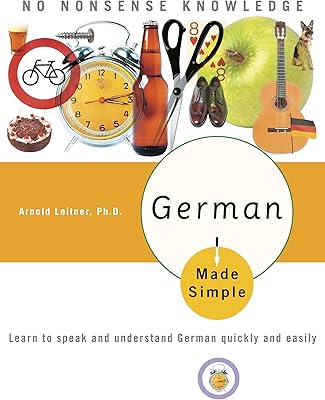
German Made Simple
Eugene Jackson
A complete beginner's guide covering grammar, vocabulary, and conversation essentials.
Check Price on Amazon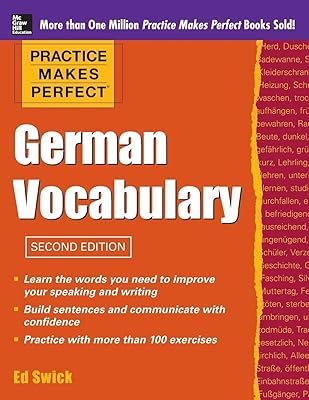
Practice Makes Perfect: German Vocabulary
Ed Swick
Targeted exercises and drills for mastering essential German words and phrases.
Check Price on AmazonAs an Amazon Associate, we earn from qualifying purchases.