How to Learn German Fast: Podcasts, Apps & Timeline
By LangPodTools Editorial Team, Language Learning Content Specialist
You've got three apps open, a podcast queued up, and a notebook full of vocabulary — but you still froze the last time a German speaker said more than "Hallo" to you. That gap between "collecting resources" and "actually understanding spoken German" is where most self-taught learners get stuck. This guide skips the motivational fluff and gives you the exact study system — podcasts, spaced repetition, and a realistic timeline — that turns passive listening into real comprehension.
Quick Answer: Most self-taught learners reach conversational A2-B1 level German in 6-9 months with 20-30 minutes of daily practice, combining one structured podcast, one spaced-repetition app, and weekly speaking practice. Skip grammar-first courses — start with high-frequency phrases and let grammar patterns emerge from context, exactly how children acquire language.
Why German Feels Harder Than It Actually Is
The short answer: German isn't harder than French or Spanish — it's just front-loaded with visible grammar. English speakers see three genders, four cases, and compound nouns in week one and panic. That's a perception problem, not a difficulty problem.
German shares roughly 60% cognate vocabulary with English [1] because both languages descend from the same Germanic branch. Words like Haus (house), Wasser (water), and Freund (friend) are nearly free vocabulary on day one.
Pro Tip: Instead of memorizing gender rules first, learn nouns as a single chunk with their article — "der Tisch," not "Tisch (masculine)." Your brain files it faster as one unit.
The Foreign Service Institute ranks German as a Category II language for English speakers — harder than Spanish, but far easier than Japanese or Arabic. That's genuinely good news if you've been dreading this.
How Long Does It Actually Take to Learn German?
Realistically, expect 600-750 hours of study to reach a solid B2 level if you're starting from zero. That breaks down very differently depending on how consistent you are.
| CEFR Level | Estimated Hours | Daily Study (6 months) | What You Can Do |
|---|---|---|---|
| A1 | 60-80 hrs | 20-25 min/day | Order food, introduce yourself |
| A2 | 150-200 hrs | 25-30 min/day | Handle daily errands, simple chats |
| B1 | 350-400 hrs | 30-35 min/day | Follow podcasts, hold real conversations |
| B2 | 600-750 hrs | 40-45 min/day | Work or study comfortably in German |
(Estimates only — actual pace varies by prior language experience and study consistency.)
Notice something important here: B1 is the tipping point where podcasts become genuinely useful instead of frustrating. Below that, most native-speed audio is just noise.
If you want a fuller roadmap with weekly milestones, our comprehensive guide to learning German breaks the whole journey down stage by stage.
The 80/20 Rule: What to Actually Study First
The 80/20 rule in German means roughly 20% of the vocabulary and grammar covers 80% of everyday conversation. That 20% is your entire first three months of study — nothing else matters yet.
Here's what actually falls inside that high-value 20%:
- The top 1,000 most frequent words (covers about 85% of casual conversation)
- Present tense conjugation for regular and the 10 most common irregular verbs
- Nominative and accusative case (skip dative and genitive at first)
- Question words: wer, was, wann, wo, warum, wie
- Modal verbs: können, müssen, wollen, dürfen
Everything else — subjunctive mood, complex relative clauses, genitive case — can wait until B1. Trying to master German grammar in perfect order, chapter by chapter, is why so many self-taught learners quit around month two.
Our German grammar guide maps out exactly which structures to prioritize and which to defer.
Podcast vs App vs Classroom: Which Method Actually Works?
No single method wins — the winning combination is one podcast for listening, one app for vocabulary retention, and occasional speaking practice. Each tool solves a different problem, and relying on just one leaves a gap.
What Each Method Is Actually Good For
Apps like Duolingo excel at habit-building and vocabulary drilling but rarely teach real spoken rhythm. Podcasts fix exactly that gap — they expose you to natural pacing, filler words, and regional accents apps can't replicate.
Classroom instruction (in-person or via italki) is unmatched for real-time correction and speaking confidence. It's also the most expensive and hardest to fit into a busy schedule.
| Method | Best For | Weakness | Cost |
|---|---|---|---|
| Podcasts | Listening comprehension, real rhythm | Passive if not paired with review | Mostly free |
| Apps (SRS) | Vocabulary retention, daily habit | Weak on natural speech | $0-$10/mo |
| Classroom/Tutor | Speaking confidence, correction | Cost, scheduling | $15-$30/session |
We recommend pairing a podcast-first routine with a spaced-repetition app — that combination consistently outperforms single-method study in learner-reported outcomes. For a curated list of listening resources once you hit intermediate level, check our advanced podcast picks.
Building a Daily German Habit With Podcasts
Consistency beats intensity — 20 minutes daily outperforms a 3-hour weekend cram session. This is backed by basic memory science: spaced, repeated exposure builds stronger retention than massed practice.
A simple daily structure that works for most self-taught learners:
- 5 minutes — Review flashcards from an SRS app (new + due cards)
- 10 minutes — Listen to one podcast segment, no subtitles
- 5 minutes — Relisten to the same segment reading the transcript
- Weekly — 15-minute speaking practice via a language exchange app
Pro Tip: Replay the same 5-minute podcast clip three times before moving on. Comprehension jumps sharply on the second and third pass — you're training your ear, not just collecting new content.
The Pimsleur German Level 1 course is worth the investment early on because its audio-only format forces active recall instead of passive reading. As of August 2026, it remains one of the few beginner courses built entirely around listen-and-repeat drilling rather than translation exercises.
Best Free Tools and Podcasts to Start With
You don't need to spend money to reach B1 German — free tools cover the first 400 hours completely. Paid tools mostly buy convenience, not results.
Start with these free resources:
- Anki for spaced-repetition flashcards — the gold standard, and free on desktop
- DW Learn German — a free podcast series from Deutsche Welle, structured by CEFR level
- Tandem or HelloTalk for free speaking exchange with native speakers
The Anki Flashcard Deck App pairs especially well with podcast study because you can build custom decks from words you actually hear, not generic textbook lists. Our full breakdown of free tools that actually work covers eight more options worth testing.
Pro Tip: Build your Anki deck from podcast transcripts, not vocabulary lists. Words you've already heard in context stick faster than words seen cold.
Common Mistakes Self-Taught Learners Make
The single biggest mistake is passive listening without active recall — letting a podcast play in the background changes almost nothing. Comprehension only improves when your brain has to work for it.
Other frequent mistakes worth avoiding:
- Chasing grammar perfection before speaking — waiting until you "know enough" to speak means you never start
- Using subtitles every single time — this trains reading, not listening
- Skipping the plateau at A2 — this is normal, not a sign you're bad at languages
- App-hopping constantly — switching tools every week resets your progress tracking and habit-building
Yes, German can absolutely be self-taught [2] — thousands of learners reach B2 fluency using only podcasts, apps, and structured practice, without ever sitting in a classroom. The key variable isn't the resource; it's consistency and active engagement with the material.
Essential German Phrases and Numbers to Learn First
"Hallo" is how you say hi in German — though "Hi" and the more casual "Servus" (regional) work too. Greetings are always the first 20 words worth memorizing because you'll use them in nearly every conversation.
Numbers 1 through 8 in German: eins, zwei, drei, vier, fünf, sechs, sieben, acht. These come up constantly — prices, phone numbers, addresses — so drill them until they're automatic.
| English | German | Pronunciation Tip |
|---|---|---|
| Hello | Hallo | HAH-loh |
| Thank you | Danke | DAHN-kuh |
| Please | Bitte | BIT-uh |
| Excuse me | Entschuldigung | ent-SHOOL-di-gung |
German has roughly 90-100 million native speakers [1] worldwide, and standard German coexists with regional dialects like Low German [5] in the north. It's also spoken as a heritage language in communities as far apart as Namibia [4] and the United States [6] — proof that basic phrases open doors well beyond Germany itself.
Final Thoughts
German rewards learners who prioritize consistent, active listening over grammar perfectionism. Browse our complete collection of German study guides to build out your full learning path, starting with our German for Beginners starter guide and rounding out listening practice with our best German movies list.
Sources
- https://en.wikipedia.org/wiki/German_language
- https://en.wikipedia.org/wiki/The_Awful_German_Language
- https://en.wikipedia.org/wiki/German_grammar
- https://en.wikipedia.org/wiki/German_language_in_Namibia
- https://en.wikipedia.org/wiki/Low_German
- https://en.wikipedia.org/wiki/German_language_in_the_United_States
Frequently Asked Questions
What is the 80/20 rule in German?▾
Can German be self-taught?▾
How do you say "hi" in German?▾
How do you say numbers 1 through 8 in German?▾
How much does it cost to learn German with apps and podcasts?▾
Do I need to learn grammar rules before speaking?▾
What's the fastest way to improve German listening comprehension?▾
Recommended Study Material
The Complete German Grammar Cheat Sheet
A1–B2 Reference PDF
27 pages of color-coded tables, mnemonics, and shortcuts — every rule you need from Cases to Subjunctive.
Recommended German Books

Short Stories in German for Beginners
Olly Richards
Learn German with 8 captivating stories. Perfect for A2-B1 learners who want to build vocabulary naturally.
Check Price on Amazon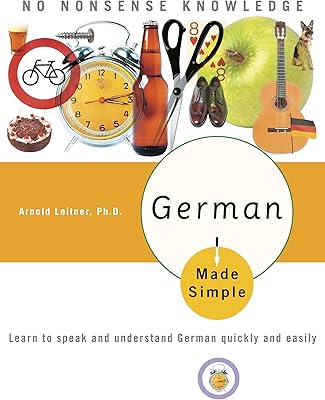
German Made Simple
Eugene Jackson
A complete beginner's guide covering grammar, vocabulary, and conversation essentials.
Check Price on Amazon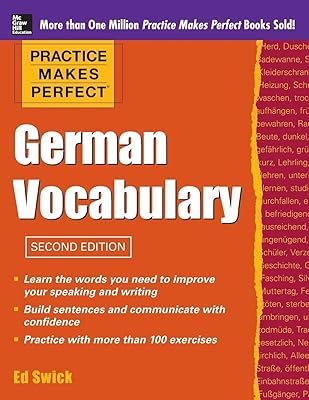
Practice Makes Perfect: German Vocabulary
Ed Swick
Targeted exercises and drills for mastering essential German words and phrases.
Check Price on AmazonAs an Amazon Associate, we earn from qualifying purchases.